
Linn County Arrest Records and Charges
Linn County arrest records start with law enforcement and jail processing. They can identify the person booked, booking date and time, bond amount, and the arrest or booking charge when those details are shown by the official roster or confirmed by the Sheriff's Office. The court charge record starts later. The Linn County County Attorney decides what formal charges to file, and the Clerk of the District Court maintains the resulting case file once the matter is opened in District Court.
The distinction is practical. A booking charge is not the final charge list. A prosecutor can file different charges, add counts, reduce a count, dismiss a count, or offer diversion. The official Linn County inmate sources are useful for current custody, while Kansas CaseSearch and the Clerk of the District Court are the better sources for filed charges and status. For the complete case file, including plea, disposition, and sentence, use the Linn County criminal court records page.
The Linn County County Attorney's Office is the local prosecutor office for charging decisions and diversion information.
The County Attorney's Office is the key local source for understanding why a filed court charge may differ from the booking charge first seen after arrest.
Arrest Charge vs Filed Charge
After an arrest, the person may be booked into the county jail. Jail staff handle intake, release processing, security, and custody operations. The booking record may list an initial charge and bond information. That record helps identify why the person was taken into custody, but it is not a full court case result. It may be based on the arresting agency's report, warrant, citation, or initial probable cause.
| Record | Who Maintains It | What It Can Show | Best Use |
|---|---|---|---|
| Booking or arrest charge | Linn County Sheriff's Office or jail system | Booking time, inmate number, bond amount, race, and charge text when shown. | Confirm current custody or recent arrest facts. |
| Filed court charge | Clerk of the District Court after prosecutor filing | Complaint, information, counts, statute references, docket status, and amendments. | Track what was formally filed in court. |
| Final disposition | District Court | Dismissal, plea, verdict, diversion outcome, sentence, costs, and restitution. | Prove what happened to each charge. |
For custody detail, the official Linn County Current Inmate Roster is the county-owned entry point.
The roster can help with booking and bond facts, but CaseSearch and the court clerk should be used to confirm filed charge status.
Find Arrest Records and Charges
Use separate channels for separate records. Check the jail roster or inmate portal first for current custody. Then search Kansas CaseSearch for the court case by defendant name or case number. If the case is not online, use the courthouse public terminal or contact the Clerk of the District Court. For public sheriff records not shown online, use the county KORA process. If the charge arose in a city ordinance matter, check the municipal court that issued the citation or complaint.
- Check the Linn County roster or inmate portal for current custody and booking details.
- Search Kansas CaseSearch by defendant name, case number, or citation if the matter is in District Court.
- Open the case docket and read each filed charge, count, amendment, and status entry.
- Use the Clerk of the District Court for certified copies or case files not displayed online.
- Use the County Attorney's Office or defense counsel for diversion or charging questions that are not answered by the docket.
The Linn County Attorney staff directory lists the prosecutor office contact details, office hours, phone, and fax.
That office is relevant to charging decisions, but the filed public case record remains with the court after charges are filed.
Charging Documents After Arrest
The charging document is the formal paper that turns an arrest allegation into a court charge record. Kansas criminal dockets may refer to a complaint or an information, depending on the filing and stage. Indictments are less common in routine county filings but are a recognized charging path when a grand jury is involved. The document should identify the defendant, counts, offense names, statute references, and the factual or legal basis for the charge.
| Document | Filed By | Common Use | What to Read |
|---|---|---|---|
| Complaint | Officer or prosecutor, depending on procedure | Initial criminal filing and many misdemeanor or felony starts. | Count number, alleged offense, date, and probable-cause basis where public. |
| Information | County Attorney or prosecutor | Formal prosecutor-filed criminal charges. | Filed charges, statute citation, severity level, and amendments. |
| Indictment | Grand jury | Serious or grand-jury-filed criminal matters. | Counts returned by the grand jury and the issuing court. |
One arrest can produce one charge or many counts. Counts can also split. For example, an arrest may involve one event, but the court file can contain separate counts for possession, obstruction, battery, or failure to appear if supported by the prosecutor's filing.
Linn County Charge Status
Charge status changes as a case moves. Read the docket in sequence. The first charge line may not be the current charge. Later events can show amendments, dismissals, diversion, plea entries, or sentencing. A count-by-count read is important because one count can be dismissed while another count ends in a conviction.
| Status | What It Means | Where It Appears |
|---|---|---|
| Pending | The charge is open and has not reached final disposition. | Docket status, upcoming hearing, or unresolved count. |
| Amended | The prosecutor or court changed the charge text, statute, level, or count. | Amended complaint, information, or docket event. |
| Reduced | A higher charge was changed to a lesser offense, often through plea negotiation. | Amended charge and plea or disposition entry. |
| Dismissed | The count or case was ended by court order or prosecutor action. | Dismissal entry, journal entry, or disposition line. |
| Diversion | Eligible prosecution is held or resolved under prosecutor-supervised terms. | Diversion agreement, docket notation, later dismissal if completed. |
| Convicted | The court accepted a guilty or no-contest plea, or a guilty verdict was entered. | Disposition, judgment, sentencing order, and financial details. |
The County Attorney page identifies Justin Meeks as Linn County County Attorney, and the Justin Meeks staff entry gives his 2025 to 2029 term.
Charging status should still be confirmed from the court docket because prosecutor office pages do not publish individual case outcomes.
Charges vs Convictions
A person can be arrested without being convicted. A person can also face charges that later change. Linn County arrest records and court charges should be read with this rule in mind: arrest is custody, charge is accusation, conviction is outcome. A public search result may show all three in different places, but they do not mean the same thing.
| Point | Charge | Conviction |
|---|---|---|
| Timing | Before final judgment. | After plea or verdict. |
| Proof level | Based on filed accusation and probable cause standards. | Based on plea accepted by court or proof beyond a reasonable doubt. |
| Can disappear from public view? | May be dismissed, sealed, or expunged if eligible. | May be expunged or restricted only through the court process and statutory limits. |
| Best record | Charging document and docket. | Certified disposition or sentencing order. |
Note: A dismissed charge can still have a docket history unless the record is sealed, expunged, or otherwise restricted.
Bond and Booking Context
Bond information links arrest records to early court events. A roster entry may show a bond amount. The court docket may show bond orders, surety, conditions, review hearings, or changes after first appearance. Linn County also publishes an approved bonding company list, which is useful when surety bond is allowed. The active list should be checked at the county source because agents, phone numbers, and bond limits can change.
The official Linn County approved bonding companies page lists companies, agents, phone numbers, addresses, and total bond limits.
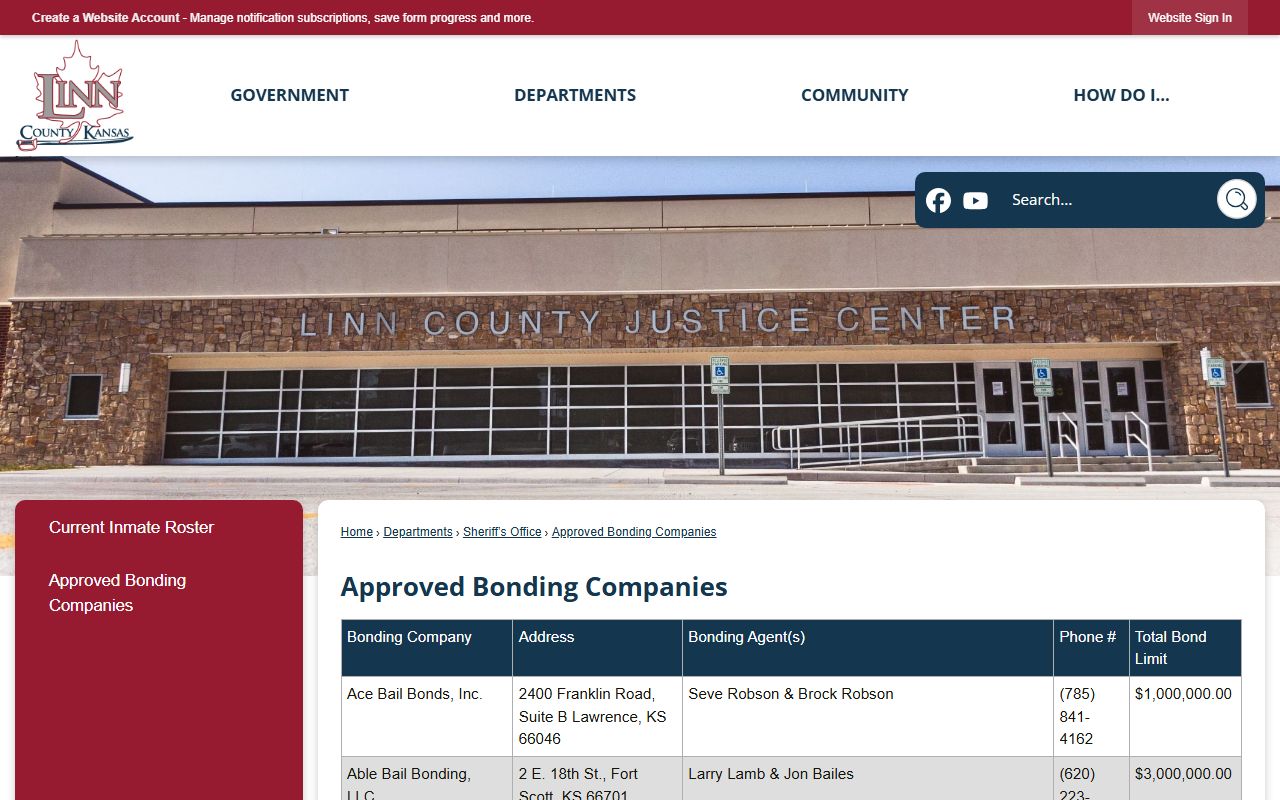
Bond information should be verified with the court or jail because release status can change after a roster update.
Statewide Charge Lookups
State databases answer questions that local court records do not. The Kansas Criminal History Record Search is a statewide criminal history product through the Kansas Central Repository. KBI registered offender search is for sex, violent, and drug offender registration. KDOC KASPER is for people sentenced to Kansas prison or under KDOC supervision. These tools can support a broader search, but they do not replace the filed Linn County charge record.
The KDOC KASPER disclaimer says offender information is updated each working day, but status may change after the update.
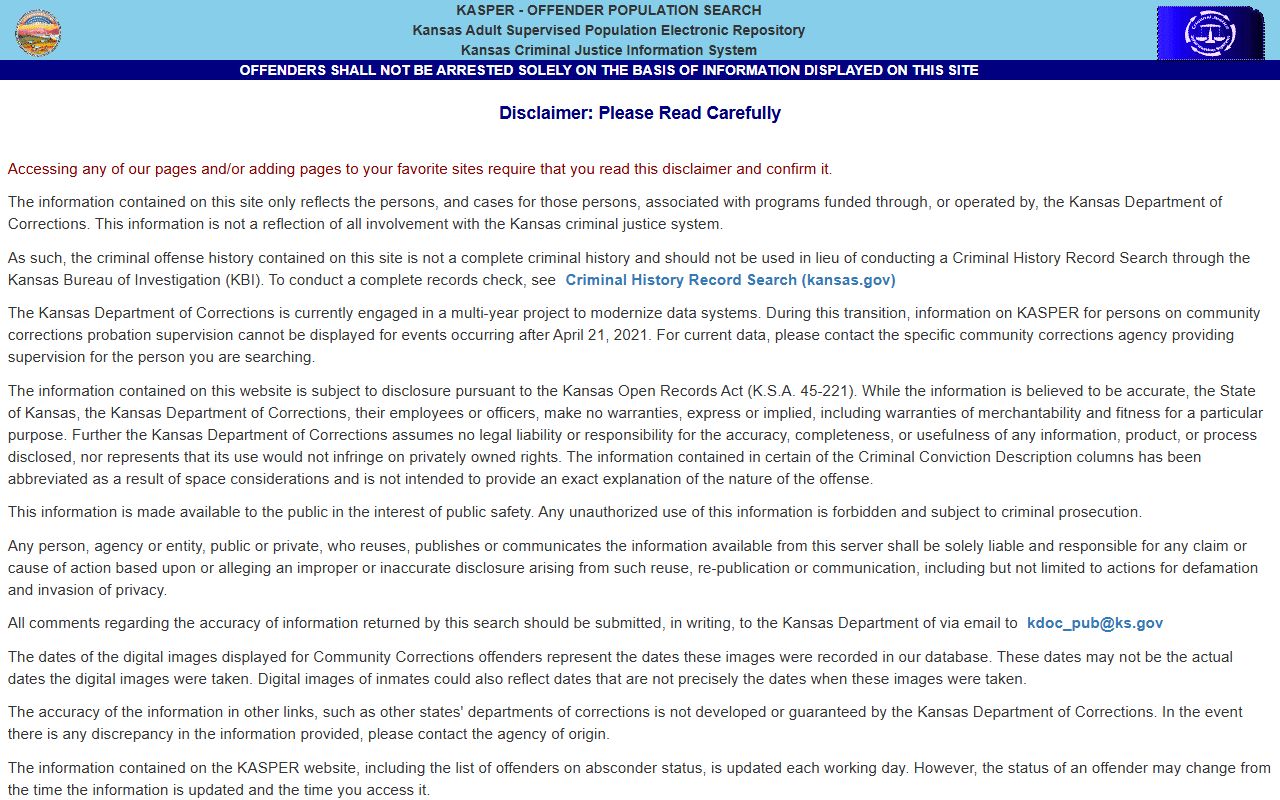
KASPER is useful after state custody or supervision begins, while filed court charges remain in the district court record.
Sealed and Expunged Charges
Kansas law can restrict public access to some charge and arrest records. Adult expungement is governed mainly by K.S.A. 21-6614 for eligible convictions, arrest records, and diversion agreements. Juvenile records follow separate statutes. Sealed cases and sealed records are not available through CaseSearch or courthouse terminals. Expungement can restrict public access, but the record may remain available for specific law-enforcement, licensing, sentencing, or statutory purposes.
| Record Type | Public Access Issue | Practical Step |
|---|---|---|
| Juvenile charge | Juvenile court and law enforcement records are restricted by Kansas statutes. | Confirm access with the court, not a public portal. |
| Sealed charge | Hidden from ordinary public search because of law or court order. | Only parties or authorized users may have access. |
| Expunged arrest or diversion | Public access is restricted after a successful petition. | Check the court that handled the case for certified status. |
| Active investigation | Sheriff or prosecutor records can be withheld under access limits. | Use KORA only for records that are public and releasable. |
Restricted Charge Records in Linn County
Restricted records include juvenile offender records, juvenile municipal and law enforcement records, sealed or expunged charge files, protected domestic records, unexecuted or sealed warrants, medical and diagnostic records, protected addresses, minor names, financial account numbers, and other identifiers. Some public dockets will show only limited events. Others will not appear online at all. A missing CaseSearch result does not prove that no arrest occurred or that no charge was ever filed.
Use the source that matches the record. The sheriff handles booking and custody records. The County Attorney handles prosecution and diversion. The Clerk of the District Court handles filed court case records. Kansas state agencies handle criminal history, registration, prison custody, and driver records. This separation is the safest way to read Linn County arrest records and court charges without mixing arrest facts with final outcomes.